Heritage vs. Hacks: Leaving Modified Watches Behind
Modified watches are not automatically illegal...
but legality depends on how they are built, described, and sold. Courts and legal commentary distinguish between private customization for an owner’s personal use and commercial resale of branded watches after modification. When a watch is customized at the owner’s request and returned to that owner, the legal risk is much lower; when a seller acquires branded watches, modifies them, and puts them back on the market, trademark issues become much more serious.
The biggest trademark concern is confusion. A watch becomes dangerous legally when the branding, dial text, logos, or presentation suggest affiliation with the original brand that does not exist, or when counterfeit or unauthorized parts are used to imitate the brand. Seiko’s own notice warns that it does not endorse or authorize modifications and flags modified watches using fake or unauthorized components as a concern.
That is why the line between a legitimate “mod” and a fake is so important. A true mod or homage is openly described as a custom build and does not pretend to be a genuine luxury watch; a counterfeit uses protected branding to deceive buyers. That distinction matters because the first is a custom product, while the second is trademark infringement.
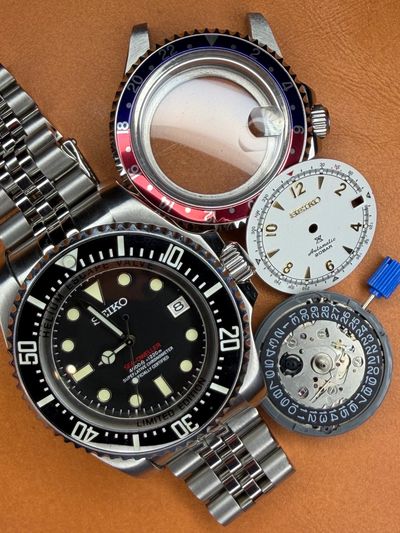
Photo by Jury + Field

But why take the risk when better watches can be found for less money?
As an example, Glycine’s appeal is different from the mod market: it offers authentic Swiss watches with genuine Swiss quartz movements and established brand heritage, rather than imitation styling or uncertain build provenance. Swiss quartz movements are widely valued for accuracy, low maintenance, and reliability, and Glycine’s heritage gives the watch collectability and brand legitimacy that modified fake Seiko-style watches cannot match.
In practical terms, buying a genuine Glycine with a Swiss quartz movement can offer better overall value than paying for a modified fake Seiko watch, because you are paying for an authentic product from a real manufacturer rather than a watch whose resale, warranty, and legal status may be compromised by counterfeit branding or misleading parts. The market commentary around modded watches repeatedly emphasizes that disclosure, provenance, and branding determine whether the watch is a lawful customization or an illegal fake.
Swiss quartz movements are a reliable choice for everyday wear, and brands like Glycine add real heritage, legitimacy, and long-term value that modified fake watches cannot replace.
Comparing a Japanese automatic movement to a Swiss quartz movement is admittedly not an apples-to-apples comparison, as they cater to entirely different mechanical preferences and watchmaking traditions. However, the core argument here centers on the overall value proposition of authenticity and true horological heritage over compromised imitation. While an automatic movement has its own distinct mechanical charm, a modified "Seiko-style" watch built with unauthorized or counterfeit parts strips away the soul and legitimacy of the brand. Ultimately, a genuine, Swiss-made watch carries a lasting legacy, guaranteed build provenance, and legal peace of mind that a modified fake simply cannot replicate—because at the end of the day, fake is still fake, and heritage is still heritage
Legal Disclaimer: This page discusses trademark concepts, modified watches, and legal commentary for educational and informational purposes only. juryandfield.com and its authors are not trademark attorneys, patent lawyers, or legal professionals. Nothing in this article constitutes formal legal advice, nor does reading it establish an attorney-client relationship. Trademark laws regarding modified goods vary significantly by jurisdiction. Please consult a licensed intellectual property attorney for advice regarding specific legal questions or branding concerns.
We are also not affiliated with any of the brands on this page. However, we are a HUGE fan of Glycine Watches.
Photo by Jury + Field